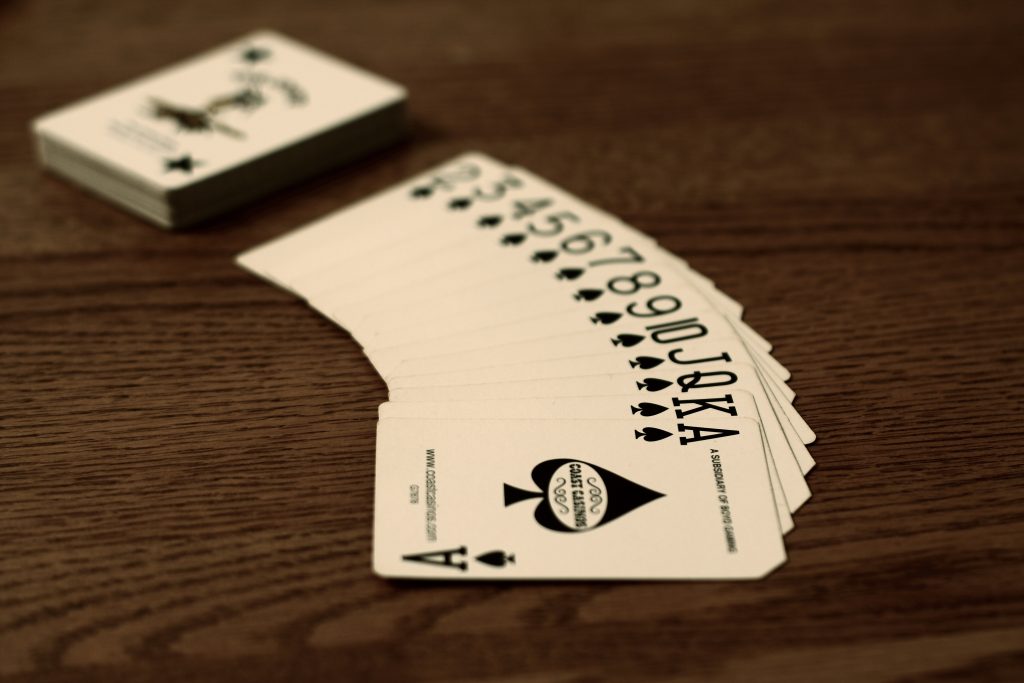
<p><span style="font-weight: 400;">Imagine playing a digital card game on a Tuesday night, tracking which cards have already appeared and deciding how to use a limited hand. Two nights later, you sit at a kitchen table with friends for Hearts or Spades. The presentation is different, but familiar questions return: what is visible, what remains unknown, and which choices will still matter on the next turn?</span></p>
<p><span style="font-weight: 400;">Physical and digital card games share useful ideas about information, resources, and uncertainty. Moving between them does not automatically make someone an expert, because each ruleset has its own demands. It does, however, create opportunities to recognize familiar patterns and approach an unfamiliar game with better questions.</span></p>
<h2><b>Imperfect Information and Risk Assessment</b></h2>
<p><span style="font-weight: 400;">Abstract board games such as chess and checkers let both players see every piece and the current position. Players can identify legal moves from that shared information, even when choosing among them is difficult. Many card games add concealed hands or an unknown draw order, so players must make decisions without seeing the full state.</span></p>
<p><span style="font-weight: 400;">In formal </span><a href="https://plato.stanford.edu/entries/game-theory/"><span style="font-weight: 400;">game theory</span></a><span style="font-weight: 400;">, imperfect information concerns choices made without observing all earlier moves, including relevant hidden events. A concealed deal provides a familiar example. In an ordinary card game, remembering what has already been played can narrow the possibilities without revealing another person&#8217;s hand. That distinction between evidence and certainty is useful across both physical and digital formats.</span></p>
<p><span style="font-weight: 400;">Digital deckbuilders use shuffled draws to create similar uncertainty. Games such as Slay the Spire and Balatro combine familiar cards with different goals and scoring systems. Understanding a deck&#8217;s composition helps a player anticipate what might appear next, but what&#8217;s available and what a useful card means depend on the game.</span></p>
<h2><b>Resource Economy and Tempo Control</b></h2>
<p><span style="font-weight: 400;">Every well-designed card game restricts how much a player can accomplish on a single turn. Traditional games enforce these limits through rules around turn order, following suit, or the number of cards a player may use. Digital card games frequently formalize the restriction through mana crystals, energy pools, or action points that refresh each round.</span></p>
<p><span style="font-weight: 400;">Despite different labels, both systems revolve around resource economy and tempo. Tempo refers to the pace at which a player develops an advantage and forces an opponent onto the defensive. Spending your strongest card early might secure immediate board control, but it can leave you vulnerable if the match drags into later rounds. Conversely, hoarding resources for a massive late-game turn accomplishes nothing if you lose before you can spend them.</span></p>
<p><span style="font-weight: 400;">Consider how a player manages a high-value trump card in Spades compared to holding a board-clearing spell in a digital battler. Playing the trump card too early stops a minor threat but costs you control during critical final tricks. Holding the digital spell one turn too long allows an aggressive opponent to deal lethal damage before the reset arrives. Recognizing when to spend resources for immediate stability versus saving them for maximum impact is a universal discipline.</span></p>
<h2><b>Reading Opponents and Behavioral Patterns</b></h2>
<p><span style="font-weight: 400;">Mechanics and probability provide the foundation of card strategy, while human psychology supplies the tension. Even when players cannot see each other&#8217;s faces across an online matchmaking queue, behavior leaves a trail of clues.</span></p>
<p><span style="font-weight: 400;">At a physical table, players can ask questions, explain decisions, and observe the sequence of play. Digital games expose some clues through visible actions and turn histories, depending on the interface. Timing is ambiguous: a long pause may reflect a difficult choice, a connection problem, or an interruption. Treating every hesitation as a reliable signal gives weak evidence more weight than it deserves.</span></p>
<p><span style="font-weight: 400;">Moving a familiar format online also adds questions about the platform around the game. Readers interested in how online poker services are compared can </span><a href="https://www.pokerology.com/poker/"><span style="font-weight: 400;">find out more</span></a><span style="font-weight: 400;"> in Pokerology&#8217;s site comparison. That page concerns real-money poker operators and their features; it is not a general card-game tutorial or confirmation of local authorization. For ordinary learning, a clear rulebook and a practice mode offer a more direct introduction to turn structure and available actions.</span></p>
<h2><b>Variance, Tilt, and Long-Term Discipline</b></h2>
<p><span style="font-weight: 400;">One of the hardest lessons for newcomers in any card format is separating decision quality from immediate outcomes. Because shuffled decks introduce randomness, a terrible decision can occasionally win a round, while a mathematically sound play can lose to an unlikely draw.</span></p>
<p><span style="font-weight: 400;">Gaming communities often call the emotional frustration caused by bad luck tilt. When a player tilts, frustration overrides logic, leading to impulsive plays, abandoned game plans, and compounding mistakes. Both physical tabletop clubs and online competitive ladders test emotional resilience in identical ways.</span></p>
<p><span style="font-weight: 400;">A useful review focuses on the information available when the choice was made. Was an important rule overlooked? Was there a visible alternative? Did an unexpected draw change the result? A high chance of one outcome does not automatically make a move best, because its consequences also matter. Replays and friendly post-game discussions can reveal mistakes without turning every unlucky result into evidence of poor judgment.</span></p>
<h2><b>How Digital Design Evolves Classic Mechanics</b></h2>
<p><span style="font-weight: 400;">While digital card games owe their core rules to centuries-old tabletop traditions, software allows designers to expand what cards can do. A physical deck requires players to track every modifier manually, which puts a practical ceiling on rule complexity. Software automates bookkeeping, making some complex effects easier to manage than they would be with paper cards.</span></p>
<p><span style="font-weight: 400;">Modern digital titles introduce effects that permanently alter cards inside a deck, generate random spells mid-match, or track hidden counters across multiple rounds. Roguelike deckbuilders blend turn-based card combat with branching maps, relic upgrades, and persistent progression systems borrowed from role-playing video games. These innovations appeal strongly to video game audiences while keeping the tactile satisfaction of drawing a hand and sequencing combos intact.</span></p>
<p><span style="font-weight: 400;">Digital play can also introduce players to tabletop communities. Someone who enjoys hand management in a mobile game may become interested in a local board game cafe, a draft event, or a casual home game. Sitting across from real people brings back the social banter, physical shuffling, and shared table energy that screens can only approximate.</span></p>
<h2><b>One Shared Language of Play</b></h2>
<p><span style="font-weight: 400;">Digital and traditional card games thrive together because they speak the same strategic language. A well-timed bluff, a calculated risk on an incomplete draw, and the discipline to stay calm during an unlucky streak feel just as rewarding at a wooden table as they do on a monitor. Whether you prefer organizing physical sleeves or building custom decks online, experience with one format can provide useful questions to explore in the other.</span></p>
<p><strong>Do you prefer the tactile feel of a physical deck or the automated depth of digital card games? Let us know in the comments below! Have you found that your skills in traditional games like Spades or poker naturally carried over to digital deckbuilders like Balatro or Slay the Spire, or did a digital game inspire you to try tabletop play? Also, how do you keep &#8220;tilt&#8221; in check when an unlucky draw ruins a perfectly planned strategy? Share your thoughts and join the discussion!</strong></p>

How Card Game Strategy Connects Digital and Traditional Gaming
Tempo, tilt, and imperfect information: Why the skills you learn in traditional card games make you a better digital player.