














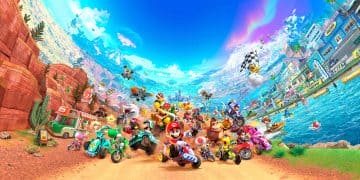





















Randomness in Mario Kart has never been a side effect. It is part of the structure that keeps a race unsettled even when the driving itself becomes familiar. A clean racing line, smart shortcut use, and good timing still matter, but item boxes constantly introduce new information that forces players to adapt. What makes Mario Kart World especially interesting is that the developers are still tuning this probability system well after release.
- The clearest recent example came with Version 1.8.0, released on September 9, 2026.
- Alongside new courses and Knockout Tour routes, the update adjusted “the probability of obtaining items from item boxes in races and Knockout Tour.”
- It was not an isolated change.
- Earlier updates in March and July 2026 also altered item acquisition probabilities, while previous patches had changed the likelihood of individual items appearing in particular situations.
- The important point is that randomness itself is being treated as something designers can balance.
- A probability table affects pacing, comeback opportunities, defensive play, and how quickly a race’s order can change.
- Adjusting those numbers can therefore reshape the experience without changing a track, vehicle, or control.
That makes Mario Kart World a useful case of a broader design principle: chance works best when it is engineered rather than simply added.
Weighted randomness is a design tool, not a coin flip
There is a major difference between pure randomness and designed randomness. A simple coin toss gives every valid outcome the same probability regardless of context. Most game systems are more deliberate, especially digital casinos and gambling sites. They use weighted probabilities, conditional rules, and carefully controlled pools of possible outcomes to produce uncertainty while still guiding the overall experience.
One familiar way to see this principle in action is to play roulette games online on a good website. In a digital version, a random-number system can select from a fixed set of outcomes according to a defined probability model. The individual result is uncertain, yet the structure behind the result is consistent. That combination of unpredictability and known boundaries is what makes probability useful as a design tool: players cannot know exactly what comes next, but they can understand the range of possibilities.
An RNG can produce different probability structures even within two versions of the same game. European and American roulette are a clear example: both can rely on the same type of random-number technology, but European roulette draws from 37 possible pockets, while American roulette uses 38 because it adds 00. Check out the explanatory video.
That small change alters the odds across the game. It shows that randomness is not only about generating an unpredictable result; designers also decide which outcomes exist and how likely each one is, much like Mario Kart’s item system.
The patch history shows probability is being tuned continuously
Mario Kart World provides an unusually visible example of probability as a live balancing variable. The official update history shows several adjustments connected directly to item frequency or acquisition chances. The developer does not publish the exact percentages behind these changes, so it would be misleading to claim that a particular item moved from one numerical probability to another. The notes do confirm repeated intervention in the distribution itself.
| Update | Release date | Probability-related change |
| Version 1.2.0 | July 29, 2025 | Reduced the chance of receiving a Triple Dash Mushroom in a low position under most item settings |
| Version 1.4.0 | December 2, 2025 | Further adjusted Triple Dash Mushroom probability and the order of receiving the Block |
| Version 1.6.0 | March 31, 2026 | Adjusted the probability of items obtained from Item Boxes during races |
| Version 1.7.0 | July 1, 2026 | Adjusted the rate at which players acquire items in races and Knockout Tour |
| Version 1.8.0 | September 9, 2026 | Again adjusted probabilities for items from item boxes |
The pattern matters more than any single update. At least five documented revisions across roughly 14 months touched some aspect of item availability or probability. That suggests item distribution is being treated as a system that can be refined independently from basic driving mechanics.
This type of tuning gives designers a relatively precise lever. Changing track layouts alters the physical challenge. Changing speed or acceleration affects vehicle performance. Changing probability affects what situations are likely to emerge. The rules may look almost identical on screen, but the flow of a race can feel noticeably different over hundreds of item draws.
Larger races make every probability decision more visible
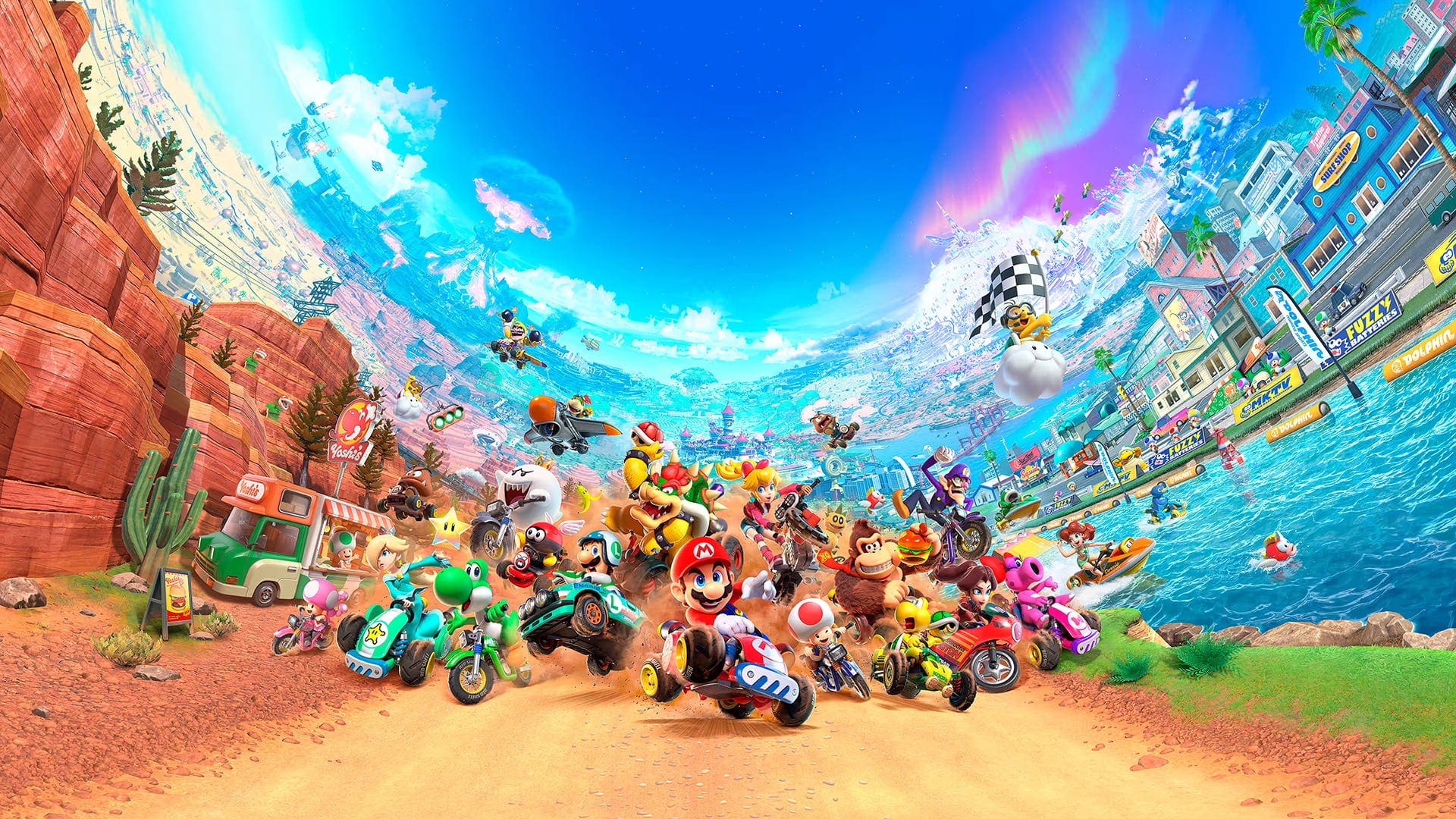
Mario Kart World also increases the scale at which its probability system operates. Standard races can contain 24 racers, compared with 12 in Mario Kart 8, effectively doubling the field. Ars Technica noted that the larger grid also means many more items can enter play whenever the pack reaches a set of item boxes.
That scale changes how randomness feels. Imagine an item with a modest probability of appearing. One draw may make that event seem uncommon. Twenty-four racers repeatedly drawing from item boxes create far more opportunities for the same event to occur somewhere in the field. Even without changing the probability attached to an individual draw, increasing the number of simultaneous draws can make rare events feel much more common during a race.
More racers make the same odds feel different
This is why probability design cannot be separated from player count, track spacing, item-box frequency, and race length. The experience emerges when they work together.
Game designer Greg Costikyan argues that uncertainty is fundamental to why games hold attention. Discussing unpredictable play in an MIT Press excerpt, he writes: “Where is the uncertainty in rock-paper-scissors? That should be obvious. It is in the unpredictability of opposing players.” His broader point applies well beyond that example: uncertainty gives players something to interpret rather than simply memorize.
Uncertainty becomes something the player has to manage
Mario Kart World layers several kinds of uncertainty at once. A full field has 23 other racers, multiple possible routes and hazards, and repeated item draws whose exact distributions remain hidden. The player’s task is therefore not to eliminate uncertainty but to manage it.
The recent probability changes reinforce that idea. Randomness isn’t outside the design. It is one of the variables being designed.
Mario Kart World shows why good random systems are rarely truly uncontrolled. The surprise comes from individual outcomes; the shape of the experience comes from the probabilities underneath them.
How do you feel about developers constantly tweaking the odds behind the scenes? Let us know in the comments below! Have you noticed the item changes in recent updates, or does the sheer scale of a 24-player race make the math impossible to track? Also, do you prefer a game where RNG is carefully managed, like grinding for an elusive piece of raid loot in World of Warcraft, or do you want racing games to stick to pure driving skill and track memorization? Share your experiences and join the discussion!


